|
Part III Bak Mei kung fu master Leung Sheung proudly demonstrated another self-defense technique to his class. Side kick, grab, punch. Leung executed the movements with as much fluence and precision as would be expected from any 20-year veteran of the fighting arts. The class then imitated the perfection of his form.
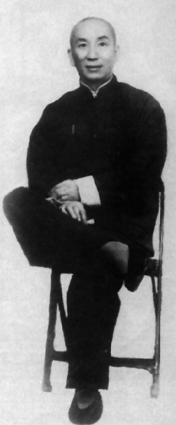
Side kick! Grab! Punch! The old man leaned against the wall for support. Now his body shuddered hysterically as he struggled to conceal his amusement. Suddenly his efforts failed completely. His silent chuckles crescendoed into loud roars of laughter. Leung stopped his class, his face reddened with anger. "Hey, old man!" he snapped. "What are you laughing at?" "Oh, nothing, nothing," he replied. "Please continue. I'll try not to disturb you further." Leung Sheung took a deep breath and paced one time back and forth across the room. He was still furious. "Look, old man, a few months ago we found you living out of garbage cans in Macao. We brought you here to the Union Hall. We gave you a place to sleep and food to eat. The least you could do Is show a little respect when I'm teaching." The old man perked up an ear. Had he heard correctly? "Respect?" "Then the least that you could do is show a little respect for the art that-you teach," growled back the old man. "All you do is have your students punch air..." He quickly moved through Leung Sheung's technique: side kick, grab, punch. "But the air doesn't hit back. What happens when you face an enemy who will?" The old man shook his head, "if you are going to practice kung fu, you should do so seriously-or not at all!" "Look old man," bellowed master Leung, "if you think you know something, why don't you come up here and teach me?" With this challenge from Leung Sheung on that day in 1952, Yip Man officially opened the doors on his 20-year career as martial arts instructor and patriarch of the wing chun style. Standing only five feet tall and weighing 120 pounds, Ylp Man proceeded to throw the six-foot, 200-pound Bak Mei (White Eyebrow) master around the room with almost no effort. No matter how Leung Sheung attacked, he always found himself carefully deposited on the floor. When all was said and done, Leung Sheung had surrendered his kung fu class at the Restaurant Workers' Union Hall to Yip Man, and had become Yip's first disciple. However, Yip Man did not happily accept his new role in life. Before World War 11, he had been a member of a wealthy merchant family in the Southern Chinese town of Fatshan, in Kwangtung Province. He owned a large manor house, a prosperous business and farm, and enjoyed a lifestyle of relative ease with his wife and family. (The story of how Yip himself learned wing chun is told in The William Cheung Story Part II.)
"Standing only five feet tall and weighing 120 pounds, Yip Man proceeded to throw the six-foot, 200 pound Bak Mei master around the room ..."
Between 1937 and 1941, Yip served in the army during China's valiant effort to repel the Japanese invasion. He returned to his family in Fatshan during the years of the Japanese occupation. Times were hard. His farm land was ruined, and his wife became ill. The end of the war brought little improvement. China needed to rebuild its ravaged cities and countryside but found itself embroiled in civil war instead. The Nationalist Chinese government recruited Yip to the post of captain of the police patrols for Namhoi County. Although the government appointment helped the living conditions of the Yip homestead, it did not come in time to prevent the death, from extended illness, of Yip Man's wife. After the Communist triumph in 1949, Yip left his two grown sons in Fatshan, and fled to Hong Kong. His position as police captain would have meant almost certain death at the hands of the Communists had he remained. Thus at the age of 51, Yip Man was forced to start an entirely new life, from scratch. "When the Communists took over," explains William Cheung, one of Yip's most senior disciples, "he lost all of his major tangible assets. But he still had whatever he could carry: money, gold bars, gold leaves, etc. But Fatshan was a very small town compared with Hong Kong and Macao. There are a lot of shrewd operators in the city. So he immediately lost some of his money through people cheating him.
"Then Leung Sheung and a chap called Cheng Kao," continues Cheung, "found him wandering around at the pier of Macao. He seemed to be homeless. They didn't know that he was a martial artist. They were just being kind. They would help anyone they could. So they took him back to the premises of the Restaurant Workers' Union Hall. They let him stay there. "When Yip Man started teaching at the Restaurant Union, he first taught Leung Sheung, Lok Yiu and Cheng Kao. Then there were a few others, like Tsui Sung Ting. Of course Leung Sheung, being a kung fu master already before he studied wing chun, progressed much faster than the rest. "A few months later the rest of us turned up." Yip Man quickly proved to be a most unusual instructor. For example, William Cheung recalls that during the seven years he spent with his teacher, he never once saw Yip ac. tually teach a wing chun class. Y1p was usually present in the back of the room, supervising the assistant instructors and correcting his favorite students, but the actual tasks of instruction were left to Leung Sheung, Lok Yiu, Tsui Sung Ting, Wong Shun Leung and William Cheung. "He never taught classes himself," says Cheung. "Well, only in some situations ... with the big clients, the ones who could pay very heavily for a private session. At those times he would often take me along. Then, suppose he was going to teach a wooden dummy technique. He would show the technique once. After that I would help the person." Yip's regular classes generally consisted of form practice, chi sao or trapping-hands drills, wooden dummy techniques, and free-sparring. There was no set pattern to the classes. Each assistant instructor was allowed to exercise some personal discretion.
"At rare times, the grandmaster might touch hands with one of his students in chi sao practice. But these occasions would only last a few seconds ..."
At rare times, the grandmaster might touch hands, with one of his favorite students in chi sao practice. But these occasions would only last for a few seconds at a time. Yip Man feared that by doing chi sao with a junior, his own technique would deteriorate. He would have to slow down for him, to create openings for him, and thus would develop bad habits. Yip was always a gentleman in dealing with his students. He had a soft-spoken style which taught more by example and suggestion than by the spoken word. He urged his students not to bully people, or to act in a rude or arrogant manner. And he tried to keep them from fighting in the street gangs of Hong Kong, though he did encourage organized competition. In the book Bruce Lee: The Man Only I Knew (Warner Books, 1975), Linda Lee quotes from an essay written by her husband for freshman English in 1961. The essay clearly illustrates the subtle tactics Yip Man would use to influence his students: "After four years of hard training in the art of gung-fu, I began to understand and felt the principle of gentleness-the art of neutralizing the effect of the opponent's effort and minimizing expenditure of one's energy. All this must be done in calmness and without striving. It sounded simple, but in actual application it was difficult. The moment I engaged in combat with an opponent, my mind was completely perturbed and unstabled. Especially after a series of exchanging blows and kicks, all my theory of gentleness was gone. My only one thought left was somehow or another I must beat him and win. "My Instructor Professor Yip Man, head of the wing chun school, would come up to me and say, 'Loong, relax and calm your mind. Forget about yourself and follow your opponent's movement. Let your mind, the basic reality, do the counter-movement without any interfering deliberation. Above all, learn the art of detachment.' "That was it! I must relax. However, right here I had already done something contradictory, against my will. That was when I said I must relax, the demand for effort in 'must' was already inconsistent with the effortlessness in 'relax.' When my acute self-consciousness grew to what the psychologists call the 'double-blind' type, my instructor would again approach me and say, 'Loong, preserve yourself by following the natural bends of things and don't interfere. Remember never to assert yourself against nature: never be in frontal opposition to any problem, but control it by swinging with it. Don't practice this week. Go home and think about it.' "The following week I stayed home. After spending many hours in meditation and practice, I gave up and went sailing alone in a junk. On the sea I thought of all my past training and got mad at myself and punched at the water. Right then at that moment, a thought suddenly struck me. Wasn't this water, the very basic stuff, the essence of gung-fu? Didn't the common water illustrate to me the principle of gung-fu? I struck it just now, but it did not suffer hurt. Again I stabbed it with all my might, yet it was not wounded. I then tried to grasp a handful of it but it was impossible. This water, the softest substance in the world, could fit itself into any container. Although it seemed weak, it could penetrate the hardest substance in the world. That was it! I wanted to be like the nature of water."
"He remarried in 1954. He was 56 and she was about 40. All of his students sort of looked down on her, and this made Yip Man very upset."
Although Bruce Lee added a bit of his own genius to the events he related in this essay, it does indicate the intellectual as well as technical heights to which Yip Man inspired his students. But at the same time, the wing chun grandmaster also had a playful streak. He loved Bruce Lee's practical jokes. Which was probably hard to do when Bruce would show up for class with itching powder, handshake vibrators, and water-squirting cameras. "He had a very good sense of humor," remembers William Cheung. "He liked to give his students nicknames, and he would take a long time to dream them up. Like Wong Shun Leung (Yip's senior student today) was called 'Wong Ching Leung,' which means that he's like a bull. I was called 'Big Husky Boy.' And Bruce (Lee) was nicknamed 'Upstart.' " Two years after Yip Man began teaching at the Restaurant Workers' Union Hall, he was asked to leave. His classes had grown so large, and included so many nonunion members, that the Union Hall had actually become a kung fu school. So Yip and his followers opened the first commercial wing chun school on Lei Dat Street in the Yaumatei District of Kowloon. Although Yip was now a self-supporting member of society, with a successful business, his life was still not a happy one. Says Cheung, "He remarried in 1954. He was about 56 and she was about 40. He met her in a restaurant, I think. Anyway, some people thought she didn't have a very clean past. All of his students sort of looked down at her, and this made Yip Man very upset. "People do not realize that life changes. It moves in cycles. Sometimes it progresses, sometimes it transcends. So there are times that you have to forget about the past. The students were very narrow-minded. They just didn't show any respect for their master. They even used to address him as 'old man' sometimes, in a very disrespectful way. "This was one of the reasons why Yip never taught a class personally. And I don't think he was doing the wrong thing by not teaching. Only after the name of Bruce Lee did they realize that the master was so great, and that the style was so great, because they saw that it could produce practi. tioners like Bruce. The students were very short-sighted." Yip's difficulties with his students. Were further aggravated by his continued drug use. According to Cheung, he would use school fees to support his psychological addiction to cocaine. Sometimes the school rent would go unpaid. By 1956 Yip had been evicted from his first school in Yaumatei.
"The thugs all had poles for carrying buckets ... Yip Man took away one of their poles, then he flattened them all within seconds."
The wing chun clan then moved to an apartment in a govern ment-su pported housing project. Yip Man both lived and taught out of the apartment. His students formed a committee which collected the school tuition, paid the rent, and left Yip with a living allowance. William Cheung recalls that during this period his master would sometimes have to fight for survival, literally. "At the time we moved to the government house, there was a re, striction on water. They only turned on the water once every four days for four hours. So you had to collect buckets of water to store until the next four days were over. "Usually I did all the chores and organization around the apartment. But that morning I was at the market and my master wanted to get some water. Now all the tenants had to get their water from the same government tap. "The local gangsters got a hold of this tap and charged everybody 50 cents a bucket. "Well, because it was so early in the morning, Yip Man didn't have the humor to argue with these characters. So he challenged them. "I had Just gotten back to the apartment when I heard the commotion. I could see what was happening and I started running toward it. Yip was fighting at least six or seven. The thugs all had poles for carrying buckets. They probably used them to threaten people. Yip Man took away one of their poles, then he flattened them all within seconds. When I got there, they were all dragging their poles, holding their heads, and running away. "From then on, every morning ... not just every four days ... but every morning, two buckets of water were delivered to the apartment." As the years passed, Yip's reputation as an instructor grew and he was eventually able to afford better accommodations. In fact, by 1964 he was able to bring his two sons and their families out of mainland China. Three years later, due in part to the prosperity brought to him through Bruce Lee's Green Hornet tame, Yip made his final move to a large, well-equipped gymnasium. Today, Yip Man's martial arts legacy has been encased in mystery. Many wing chun instructors claim to be his direct disciple, and the personal inheritor of some secret set of wing chun techniques. However, as Cheung confirms, "Probably less than six people in the whole wing chun clan were personally taught, or even partly taught, by Yip Man. Yip had to teach the first two so that the first two could teach the next six. "But Yip Man was so intelligent in the martial arts that he could not stand a slow student. He was very impatient with slow students. So he could not stand to teach more than a few. Also, he belonged to the old tradition, influenced by the Boxer Rebellion, which believed that the martial arts should not be passed on to Westerners. He even believed that wing chun should be just a household art. "Yip Man was a well-educated man who never wanted to teach kung fu. His best loves were watching soccer and attending the Chinese opera. His strongest hatred was for ignorance. That's why he did not like many martial artists. He was a man of perfection. He believed that there's no half way to doing anything. "That's why a lot of people did not understand him." In May, 1970, Yip Man permanently closed the doors on his career as a martial arts instructor. He died from throat cancer on December 2, 1972. He was 74 years old. Black Belt Magazine (Part III of a series of four articles), 1983
|
 In
the back of the room, the old man quickly turned
his head away and bit down firmly on his tongue,
swallowing his laughter.
In
the back of the room, the old man quickly turned
his head away and bit down firmly on his tongue,
swallowing his laughter.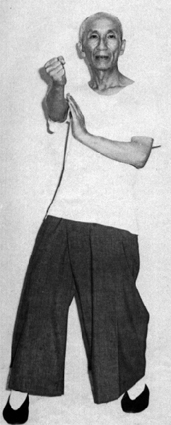 "Then
the heartbreak of losing his home, his wife,
and being separated from his family caught up
with him. He became disillusioned and perhaps
began to pity himself. Psychiatrists say that
people in a situation like that often become
dejected and turn to alcohol, drugs, gambling,
and things like that. I think that's what happened
to my master." Soon, the Chinese nobleman
found himself destitute.
"Then
the heartbreak of losing his home, his wife,
and being separated from his family caught up
with him. He became disillusioned and perhaps
began to pity himself. Psychiatrists say that
people in a situation like that often become
dejected and turn to alcohol, drugs, gambling,
and things like that. I think that's what happened
to my master." Soon, the Chinese nobleman
found himself destitute.